


7kW Vs 11kW Home EV Charger: Which One Do You Actually Need?
%20(1).webp)
Upgrading to an 11 kW home EV charger is a great way to slash charging times and future-proof your garage. Drawing power across three phases, an 11 kW AC EV charger can charge compatible vehicles up to 50% faster than a 7 kW unit.
While an 11 kW setup requires an upfront investment in three-phase wiring and utility load upgrades, the return on investment (ROI) is clear: faster charging for larger batteries, readiness for your next EV, and the ability to pack full charges into cheap off-peak power hours.
Choosing between a 7kW vs 11kW home EV charger comes down to two practical factors: your car's internal hardware limit and the electricity connection at your home.
What's The Difference Between A 7kW And An 11kW Charger?
The core difference between these two chargers is the type of electrical supply they use and how current flows through them.
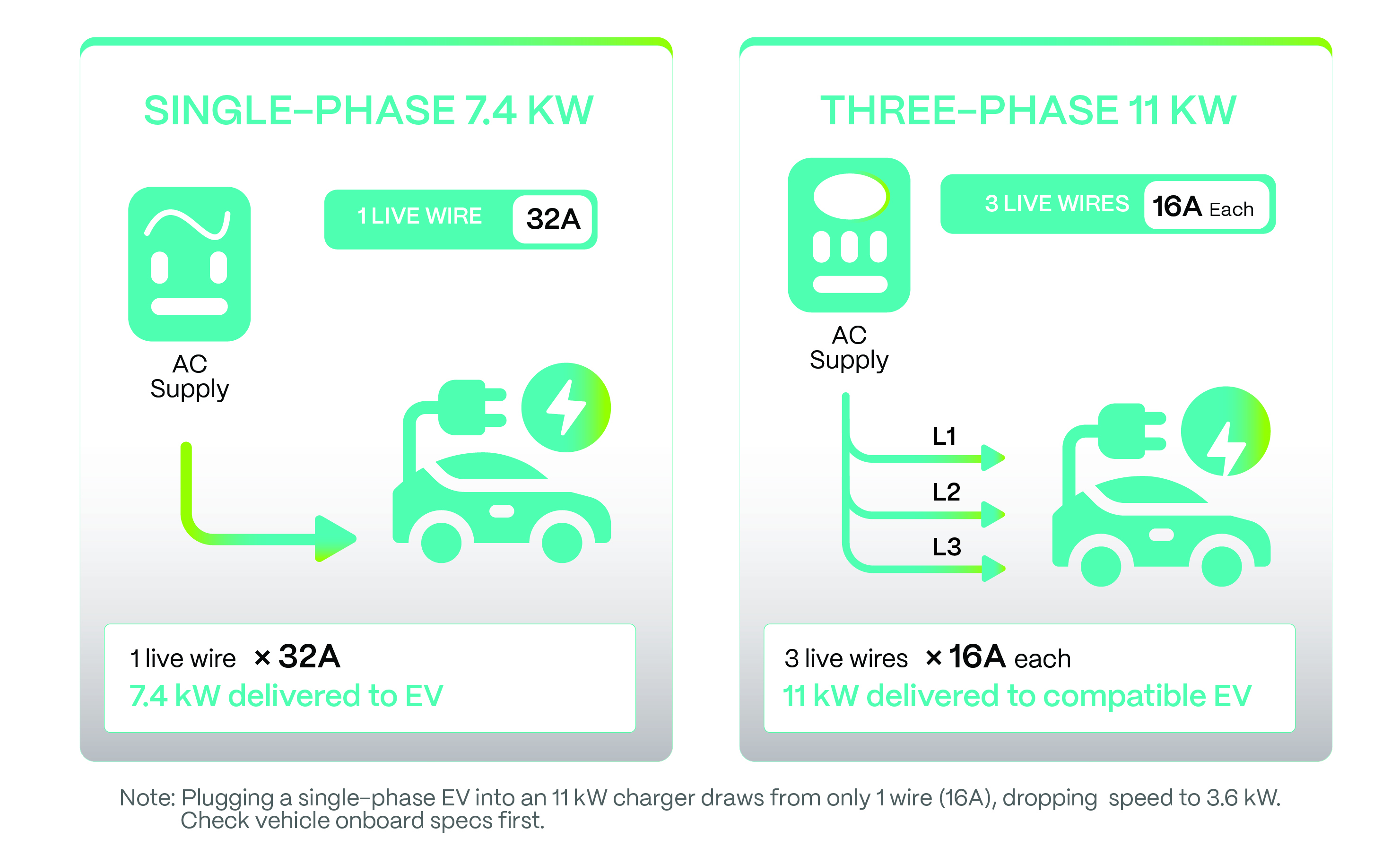
A 7kW EV charger runs on single-phase power, which is standard in most Indian homes. It draws approximately 32 amperes of current through a single live wire.
An 11kW EV charger runs on a three-phase power connection. Instead of drawing high current through one wire, it spreads 16 amperes of current across three separate live wires.
If your EV only supports single-phase charging, it can tap into only one of those three wires. On an 11 kW charger, that single wire provides only 16 amps, capping your charging speed at roughly 3.6 kW. Connecting a single-phase EV to an 11 kW three-phase EV charger will charge it at half the speed of a standard 7 kW charger.
Charging Time For A 40, 60, And 80 Kwh Battery
EV charging time depends on your battery capacity, charger output, and energy losses.
Converting AC grid power into battery DC power creates heat, while thermal management and cell balancing consume electricity during the session [cite: 5, cited: 74, 74]. Because of this, real-world charging includes 10% to 15% in standard conversion losses.
Here is how realistic charging times compare from 0% to 100% for vehicles that can accept each charger's full output:
Estimates include real-world conversion losses and final battery balancing.
Most owners do not charge from empty. For daily driving, topping up between 20% and 80% on a 7 kW charger takes just 3 to 5 hours.
Can Your EV And Your Home Use An 11kw Charger?
Before paying for extra wattage, check both your vehicle hardware and your home distribution board.
Your EV's Onboard Charger Sets The Real Charging Speed
A wallbox is an AC EV charger that safely routes electricity from the grid into the car. Inside the car sits an onboard charger (OBC), which converts alternating current (AC) into direct current (DC) for the battery pack.
The OBC sets the upper limit on charging speed. If your car's OBC is rated at 7.2 kW, plugging into an 11 kW or 22 kW charger will still give you a maximum of 7.2 kW. The EV simply ignores the extra power capacity.
11kW Charging Needs A Three-Phase Power Connection At Home
An 11 kW charger requires a three-phase connection to operate. Standard single-phase residential wiring cannot deliver 11 kW safely.
Simply having a three-phase meter is not enough. You must verify your sanctioned load with your electricity board (DISCOM). An 11 kW charger adds an 11 kW continuous load. If your sanctioned load is 5 kW or 8 kW, running the charger will trip your main breaker or attract utility penalties.
To charge at 11 kW while running heavy appliances like air conditioners and geysers, homes generally require a sanctioned load of 14 kW or more.
Which EV Home Charger Should You Buy: 7kW Or 11kW?
Base your purchase on hardware compatibility rather than speculative future needs.
.jpg.jpeg)
Choose 7kw If Your EV Caps At 7.2kw Or Your Home Has Single-Phase Power
A 7kW home EV charger is the practical, straightforward choice for most Indian homes. It matches the onboard charging speed of most EVs on the market and runs on common single-phase connections.
An overnight charge of 7 to 8 hours easily tops up a 40 kWh to 50 kWh battery to full capacity before morning, making it reliable for everyday EV charging at home.
Choose 11kw Only If Both Your EV And Your Home Support It
An 11kW home EV charger makes sense only when:
- Your vehicle has an 11 kW onboard AC charger.
- Your home has an active three-phase electrical supply.
- Your sanctioned load can safely support the additional 11 kW demand.
This setup works best for vehicles with large battery packs (60 kWh to 80 kWh), saving you 2.5 to 4 hours on a full charge.
How Much More An 11kw Setup Costs To Install
Professional EV charger installation for an 11 kW charger costs more than a standard 7 kW setup due to infrastructure requirements:
Note: DISCOM enhancement charges vary by state tariff regulations and security deposits.
Which Charger Exicom Spin Air Supports
The Exicom Spin Air charger series is designed for Indian residential conditions and covers both power standards:
- Spin Air 7.4 kW: A single-phase 32A charger for standard residential connections, matching vehicles with 7 kW to 7.4 kW onboard chargers.
- Spin Air 11 kW / 22 kW: Three-phase chargers built for homes with approved three-phase power and vehicles with higher AC intake limits.
The Spin Air lineup comes with an IP66 weather-resistant enclosure, IK10 impact protection, and integrated earth leakage safety. Using the Spin Control app, you can schedule charging during off-peak hours and manage household power loads.
Before buying, check your car's AC onboard charger rating and your home meter's sanctioned capacity to select the right model for your parking spot.
Frequently Asked Questions
Lorem ipsum dolor sit amet, consectetur adipiscing elit, sed do eiusmod tempor incididunt ut labore et dolore magna aliqua. Ut enim ad minim veniam, quis nostrud exercitation ullamco laboris nisi ut aliquip ex ea commodo consequat. Duis aute irure dolor in reprehenderit in voluptate velit esse.
Lorem ipsum dolor sit amet, consectetur adipiscing elit, sed do eiusmod tempor incididunt ut labore et dolore magna aliqua. Ut enim ad minim veniam, quis nostrud exercitation ullamco laboris nisi ut aliquip ex ea commodo consequat. Duis aute irure dolor in reprehenderit in voluptate velit esse.
Lorem ipsum dolor sit amet, consectetur adipiscing elit, sed do eiusmod tempor incididunt ut labore et dolore magna aliqua. Ut enim ad minim veniam, quis nostrud exercitation ullamco laboris nisi ut aliquip ex ea commodo consequat. Duis aute irure dolor in reprehenderit in voluptate velit esse.
Lorem ipsum dolor sit amet, consectetur adipiscing elit, sed do eiusmod tempor incididunt ut labore et dolore magna aliqua. Ut enim ad minim veniam, quis nostrud exercitation ullamco laboris nisi ut aliquip ex ea commodo consequat. Duis aute irure dolor in reprehenderit in voluptate velit esse.
Lorem ipsum dolor sit amet, consectetur adipiscing elit, sed do eiusmod tempor incididunt ut labore et dolore magna aliqua. Ut enim ad minim veniam, quis nostrud exercitation ullamco laboris nisi ut aliquip ex ea commodo consequat. Duis aute irure dolor in reprehenderit in voluptate velit esse.